
When Logistics Define Project Success
In major capital projects, the greatest risks often begin after fabrication is complete. You can engineer the most advanced process module and execute flawless assembly, but if transport to the installation site becomes delayed or unpredictable, the entire project is at risk.
For decades, energy and infrastructure developers have struggled with the challenge of transporting massive, oversized modules overland. The journey from yard to site often introduces as much uncertainty as the build itself.
Hidden in plain sight, the Gulf Intracoastal Waterway provides a faster, safer, and more reliable logistics route—one that transforms how offshore and coastal energy modules reach their destinations.
The Over-the-Road Nightmare: A Story of a Thousand Cuts
Picture your completed 300-ton pipe rack module sitting on the fabrication floor. If the yard is landlocked, the hardest part of the job is still ahead. Overland transport for loads of this scale is a logistical maze.
Permitting Purgatory:
Every county and state on the route requires separate permits for oversized transport. The process is slow, inconsistent, and vulnerable to administrative delays.
Infrastructure Bottlenecks:
Transport routes are dictated not by efficiency, but by obstacles, low bridges, narrow overpasses, and power lines that must be raised or rerouted.
Escorts and Road Closures:
Large loads demand pilot vehicles, police escorts, and night-only travel windows. Each layer adds cost and coordination challenges.
Design Limitations:
Road height and width restrictions often force engineers to break down larger, more efficient modules into smaller, less optimal sections simply to fit within transport limitations.
Each stage introduces friction—a “thousand cuts” that drain time, elevate risk, and inflate project costs.
The Waterway Solution: A Direct Path to Project Certainty
Now consider a different scenario.
Your 300-ton module is completed at a fabrication yard with direct access to the Gulf Intracoastal Waterway. Instead of facing a patchwork of overland obstacles, your transport plan becomes a single, controlled marine operation.
The Gulf Waterway offers a continuous, protected marine corridor maintained by the U.S. Army Corps of Engineers—linking fabrication facilities directly to the Gulf of Mexico. This route eliminates nearly every variable that slows or jeopardizes overland transport.
The Journey of a Module: From Our Yard to Your Site
Seamless Loading:
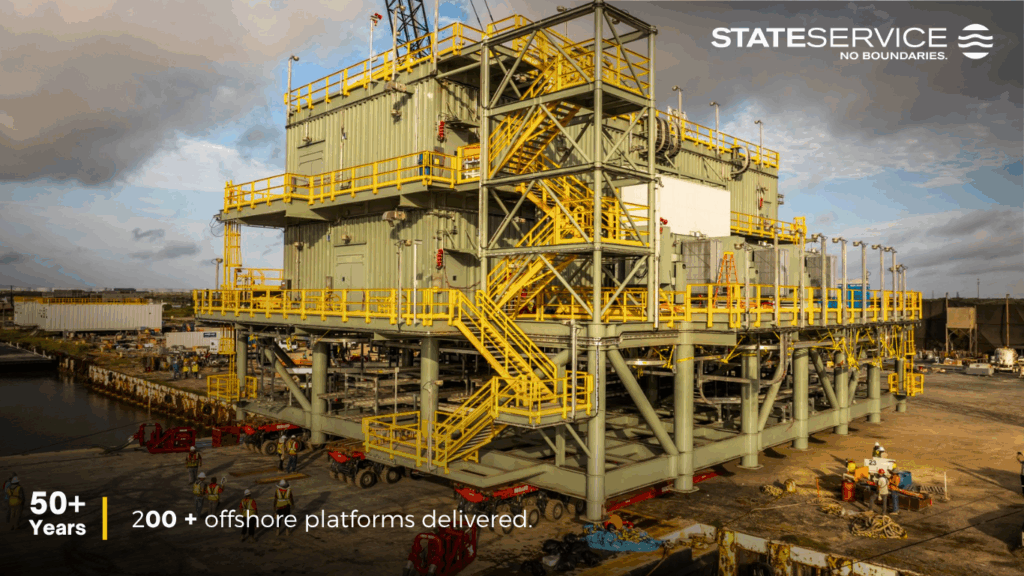
Modules are transferred from the fabrication area to a 1,200-foot load-bearing bulkhead using self-propelled modular transporters (SPMTs), avoiding complex truck rigging or roadway restrictions.
Direct Barge Access:
Modules are loaded directly onto a waiting barge. The process is faster, safer, and less complex than overland loading, with minimal lifting and fewer touchpoints.
The Marine Highway:
Once afloat, the barge enters the Gulf Intracoastal Waterway, a protected marine corridor with minimal traffic and no physical obstructions.
Direct to Offshore:
From the waterway, modules move straight into the Gulf of Mexico, arriving at shallow-water or deepwater installation sites without delay.
Each phase of this journey is optimized for speed, safety, and control, eliminating the uncertainties that overland routes introduce.
The Tangible Benefits of Waterway Logistics
Access to the Gulf Waterway isn’t just a convenience, it’s a measurable performance advantage.
Schedule Acceleration
By bypassing weeks of permitting and road transport preparation, marine logistics compresses project schedules and helps teams meet critical installation windows.
Enhanced Safety
Marine transport minimizes exposure to public roadways and reduces heavy-lift risks, resulting in a safer logistics environment for both crews and cargo.
Design Freedom
When transport constraints are removed, engineers can design larger, more integrated modules, such as deeper pipe racks and larger e-buildings, thereby reducing offshore hookup and commissioning time.
Cost Certainty
Land transport involves dozens of fluctuating costs—permits, escorts, route modifications, and downtime. Marine logistics replaces these variables with one predictable, fixed-cost transport plan.
Your Fabrication Partner Should Also Be Your Logistics Partner
Fabrication quality means little if modules can’t reach their destination safely and on schedule. Choosing a waterfront fabrication partner ensures that logistics are integrated into your project, not an afterthought.
At State Service Co., our strategic location on the Gulf Intracoastal Waterway is a cornerstone of our value proposition. For nearly 50 years, we’ve understood that true project certainty requires control over every stage, from engineering and fabrication to delivery and installation.
Our 70-acre waterfront facility in Ingleside, Texas, combines heavy-lift capacity, direct barge access, and experienced marine coordination teams—all designed to move your modules from yard to site with unmatched precision and predictability.
Don’t let land-based logistics create unnecessary risk. Choose a partner with direct waterway access and a proven record of delivering large-scale offshore modules safely and efficiently.
About State Service
Since 1976, State Service has provided innovative EPC/EPCI solutions to companies in every energy sector. Our growth over the last four decades demonstrates our unsurpassed commitment to project excellence and innovation, along with a steadfast focus on quality, safety, reliability and timeliness.
We pride ourselves on our veteran team. Combine our experienced team with our strategically located fabrication facility along the Gulf Intracoastal Waterway in Ingleside, Texas, and we are positioned to see your project from inception through completion.
Frequently Asked Questions
1. What is the Gulf Intracoastal Waterway?
A federally maintained marine corridor that runs along the Gulf Coast, connecting inland fabrication yards directly to the Gulf of Mexico.
2. Why is waterway access important for modular fabrication?
It allows modules to be transported by barge directly to offshore or coastal sites, eliminating road-based constraints and reducing schedule and safety risks.
3. How does marine transport improve project certainty?
By removing permitting, road logistics, and infrastructure limitations, marine transport enables faster, safer, and more predictable delivery timelines.
4. What types of projects benefit most from waterway logistics?
LNG facilities, offshore production platforms, petrochemical plants, and marine terminals all benefit from direct waterway transport for large or heavy modules.