
In the petrochemical and refining industries, time is not just money, it is millions of dollars in lost revenue per day. When a facility undergoes an expansion, a system upgrade, or a critical turnaround (TAR), the ultimate goal is to minimize operational downtime and get product flowing again as quickly and safely as possible.
For decades, the standard approach was traditional “stick-built” construction. Materials were shipped to the plant, and armies of contractors assembled piping, vessels, and structural steel directly on-site. Today, plant managers and EPC directors know that stick-building inside a live, operating brownfield site is a logistical and financial liability.
The modern solution to expanding petrochemical infrastructure is off-site modular fabrication. But not all modular strategies are created equal. Delivering true “plug-and-play” process modules requires a fabrication partner with the infrastructure to build, test, and ship on a massive scale.
The “Hot Work” Trap of On-Site Construction
Building inside a live petrochemical plant is an exercise in extreme risk management. Space is severely restricted. Workflows clash with daily plant operations. Every welding arc requires highly restrictive hot work permits, and safety hazards are multiplied by the presence of volatile hydrocarbons.
Furthermore, bringing hundreds of outside contractors into a secure, active facility creates a logistical nightmare for plant security and safety managers. When bad weather hits, or when a permit is delayed, the entire construction schedule halts, pushing the turnaround deadline further into the red.
The Modular Advantage: Taking the Risk Out of the Blast Zone
Modular fabrication fundamentally changes the risk profile of a capital project. By shifting the construction of Pre-Assembled Units (PAUs), Pre-Assembled Racks (PARs), and complex process skids away from the live plant and into a controlled fabrication yard, project owners achieve immediate strategic advantages.
First, it enables parallel execution. While civil engineers are pouring foundations and prepping the site at the refinery, the process modules are being fabricated simultaneously in the yard. This compresses the overall project schedule by weeks or even months.
Second, it radically improves safety and quality. In a dedicated fabrication yard, welding is performed in controlled environments, protected from the elements. Ergonomics are optimized, and QA/QC inspections are streamlined. The work is removed from the explosive environment of the plant, protecting both the facility’s operators and the construction crews.
Showcasing State Service Co.: Infrastructure Built for Petrochemical Scale
Building a highly complex petrochemical module is only half the challenge; moving it is the other. Many inland fabricators are forced to build smaller modules because they are restricted by highway weight limits and overpass heights. This requires the modules to be shipped in pieces and bolted together at the plant, defeating the purpose of modularization.
State Service Co. (SSCI) eliminates this bottleneck. From our 70-acre waterfront facility in Ingleside, Texas, we serve the entire Gulf Coast petrochemical corridor, from Corpus Christi to the Houston Ship Channel and into Louisiana.
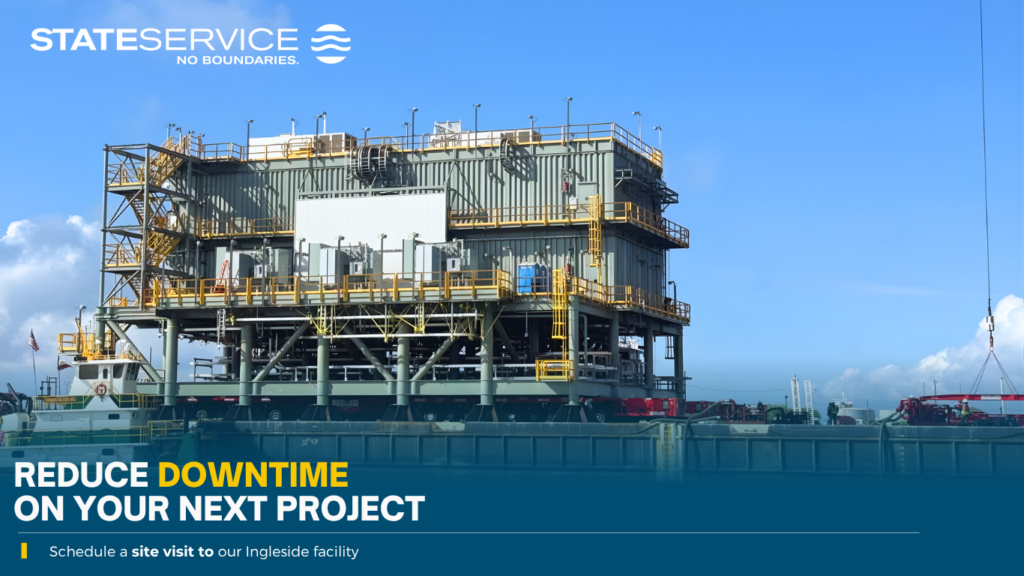
Our infrastructure is engineered for massive scale. With cranes capable of lifting 500+ tons, we build upward and outward, fabricating enormous, fully integrated process modules. Because we operate 2,000 linear feet of load-bearing bulkhead on the Gulf Intracoastal Waterway, we bypass road transport entirely. We load towering petrochemical modules directly onto barges for seamless delivery right to your plant’s heavy-haul dock.
Integrated Integrity: Ready to Plug and Play
A module is not truly “plug-and-play” if it arrives at your plant untested.
Every time a module is installed, there is a risk of leaks or debris contaminating your downstream equipment. SSCI mitigates this through our integrated Facility Integrity Services (FIS) Division. We do not just weld the steel; we prove the system.
Before a petrochemical module ever leaves our Ingleside yard, it undergoes rigorous, documented testing. Our veteran FIS teams perform precision torquing, hydrostatic or nitrogen pressure testing, and thorough pipeline pigging and cleaning. When the module arrives at your facility, it is clean, certified, and ready for immediate tie-in and commissioning.
Shift Your Project Hours. Lower Your Project Risk.
In the petrochemical sector, the most expensive and dangerous place to turn a wrench is inside a live plant. The smartest EPC execution strategies focus on maximizing off-site modularization.
Don’t let your next expansion or turnaround be dictated by on-site congestion and hot work delays. We invite plant managers, engineering directors, and procurement teams to verify our execution capacity in person.
About State Service Co.
Since 1976, State Service has provided innovative EPC/EPCI solutions to companies in every energy sector. Our growth over the last four decades demonstrates our unsurpassed commitment to project excellence and innovation, along with a steadfast focus on quality, safety, reliability and timeliness.
We pride ourselves on our veteran team. Combine our experienced team with our strategically located fabrication facility along the Gulf Intracoastal Waterway in Ingleside, Texas, and we are positioned to see your project from inception through completion.
Schedule a site visit Come walk our 70-acre waterfront facility. Inspect our heavy-lift capabilities, see our FIS testing command centers, and discover how SSCI’s modular fabrication infrastructure is the ultimate tool for minimizing your plant’s downtime. Contact State Service Co. today to schedule your visit.