
Introduction
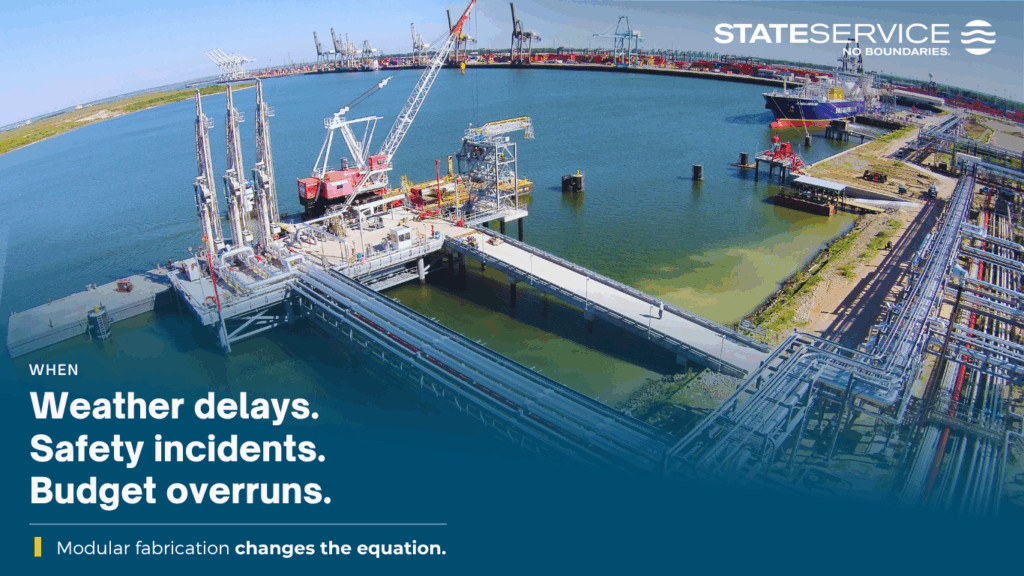
In the Gulf Coast energy sector, every decision directly influences safety, budget, and schedule certainty. Whether you’re developing an offshore platform, LNG facility, or coastal terminal, the construction method you select defines your project’s performance.
Two main methods drive energy infrastructure today: traditional stick-built construction and modern modular fabrication. While both approaches can deliver strong results, modular fabrication stands out as the more predictable and risk-controlled strategy, especially under Gulf Coast conditions.
Understanding the Construction Methods
Stick-Built Construction
Stick-built construction is the classic on-site method. Materials, labor, and equipment are mobilized directly to the field, and the entire project, from foundations and steel to piping and commissioning- is executed step by step in the open environment.
This method has long been the standard, but it carries inherent challenges related to weather, safety, and productivity.
Typical Challenges:
- Exposure to high heat, humidity, and sudden storms
- Crews working at heights of 100 feet or more
- Congested worksites and overlapping trades
- Limited on-site medical and emergency response
- Average of 4.7 recordable incidents per 200,000 work hours
Modular Fabrication
Modular fabrication, often called offsite construction, shifts major portions of the build into controlled environments. Entire facility sections—modules—are fabricated with pre-installed equipment, piping, and electrical systems before being transported to the site for integration.
This approach enables precise, factory-level quality control and allows critical path work to continue regardless of weather.
Key Advantages:
- Up to 80% of work completed at ground level in protected fabrication yards
- Consistent productivity under stable environmental conditions
- Standardized safety procedures and immediate emergency access
- 60% fewer recordable safety incidents than traditional field construction
- Parallel workflows that compress schedules and reduce downtime
Performance Comparison: Modular vs. Stick-Built
Safety and Risk Reduction
Stick-Built:
Exposure to Gulf Coast weather, elevated workloads, and site congestion increase incident rates and slow productivity.
Modular:
Most work occurs indoors at ground level. Fabrication yards apply strict safety systems, automated monitoring, and controlled access, resulting in a safer, more predictable work environment.
Documented Result: Up to 60% fewer incidents and higher worker retention.
Schedule Reliability and Delivery
Stick-Built:
Sequential construction creates dependency bottlenecks. Gulf Coast weather delays and variable labor productivity contribute to average schedule overruns of 15% on major energy projects.
Modular:
Parallel execution of site work and module fabrication enables consistent progress. With 85% of total work hours unaffected by weather, modular projects maintain stable timelines and fewer disruptions.
Result: 20–30% faster completion and 35% better on-time performance.
Cost Control and Budget Predictability
Stick-Built:
Budgets fluctuate due to weather delays, overtime costs, and onsite inefficiencies. Even minor disruptions can trigger cascading cost impacts.
Modular:
Controlled environments stabilize labor performance and reduce material waste. Bulk procurement, standardized processes, and minimized rework lower total installed cost and improve financial predictability.
Result: Reduced cost variability and higher return on capital.
Quality Assurance and Precision
Stick-Built:
Open-air construction limits quality oversight. Environmental factors can compromise welding, coatings, and fit-up tolerances, often leading to rework and schedule slips.
Modular:
Fabrication yards use advanced QA/QC tools—laser scanning, automated welding, digital inspection—to maintain precision and repeatability. Each module undergoes multiple quality verifications before shipment.
Result: Higher consistency, fewer defects, and faster commissioning.
Timeline Visualization
Stick-Built:
Site Prep → Foundations → Structural Steel → Piping → Electrical → Commissioning
Each step depends on the last, extending total duration.
Modular:
Site Prep + Offsite Fabrication → Module Delivery → Installation → Commissioning
Parallel workflows shorten schedules and reduce environmental exposure.
Choosing the Right Method
For small, less complex builds, stick-built construction remains a practical choice.
For large-scale Gulf Coast energy projects—where schedule reliability, safety, and cost control are critical—modular fabrication delivers the highest certainty of success.
This approach transforms field construction into a predictable, high-precision manufacturing process designed for complex energy infrastructure.
Partner with a Proven Modular Fabricator
Selecting modular construction is only part of the solution—the right partner brings the process to life.
State Service Co., a trusted Gulf Coast fabricator with nearly 50 years of EPCI (Engineering, Procurement, Construction, and Installation) experience, operates from a 70-acre waterfront facility in Ingleside, Texas.
Our team has delivered over 200 offshore platforms and thousands of precision-engineered modules, helping clients achieve consistent project outcomes in the region’s most demanding environments.
Partner with experience. Build with certainty.
Contact State Service. to discuss your upcoming energy project.
Frequently Asked Questions
1. What is modular fabrication in energy construction?
It’s the process of building large, pre-assembled components in a controlled environment, then transporting them for on-site installation.
2. Why is modular construction well-suited for Gulf Coast projects?
Because Gulf Coast projects face unpredictable weather, modular fabrication minimizes downtime by moving most work to protected facilities.
3. How does modular construction improve safety?
By reducing elevated work and environmental exposure it lowers incident rates by as much as 60%.
4. Which industries benefit most from modularization?
LNG, petrochemical, offshore oil and gas, and marine terminal projects see the most benefit from modular approaches due to scale and complexity.